
Why is a first dental checkup important?
A first dental checkup matters because baby teeth do real work long before they fall out. They help your child eat and speak and hold the space the adult teeth need. Untreated cavities in baby teeth can cause pain and infection and disturb your child's sleep and eating, says the Public Health Agency of Canada.
Ask who will see your child when you book. One of our dentists is Dr. Katy, a general dentist whose bio describes extensive experience treating children and adolescents.
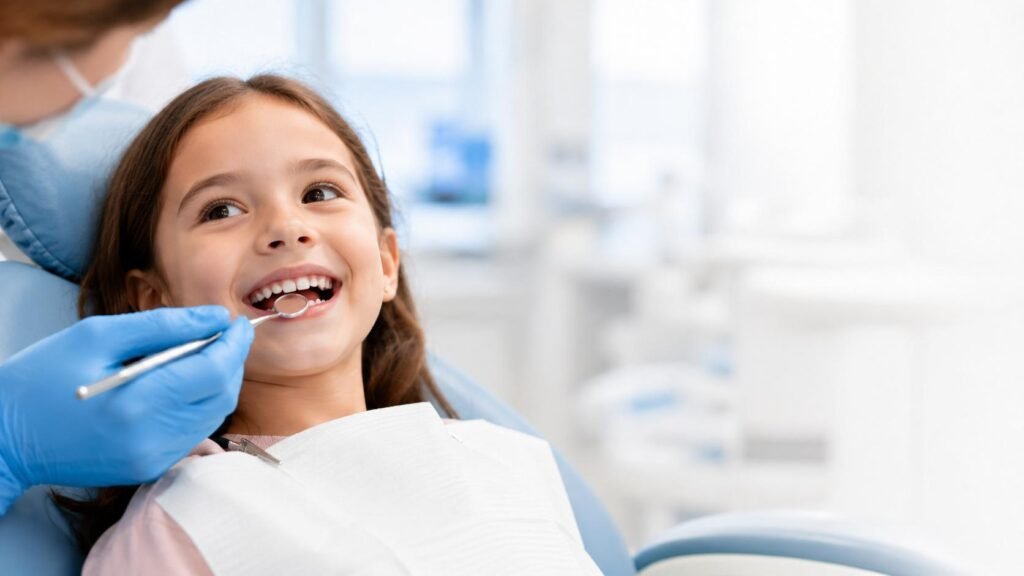
What happens at your child's first dental exam in Vaughan?
The first exam has three parts: a welcome for your child, a gentle check of the mouth and a talk with you.
- A welcome. The dentist gets to know your child and helps them feel comfortable.
- A gentle exam of the teeth, gums and bite for early signs of decay.
- A talk with you about the findings and your questions on toothpaste, bottles and soothers. Then the dentist recommends what comes next.
How does a dentist examine a baby or toddler?
International guidelines on children's dental injuries name the knee-to-knee exam as a helpful way to examine a young child. You sit facing the dentist with your knees touching. Your child lies back across both laps, so they can still see and feel you.
Ask the team how they will examine your child. You can also ask them to show your child each tool first and keep the exam short.
How do you prepare your child for a first dental visit?
Prepare your child with calm words, such as "the dentist will count your teeth." The CDA suggests you explain what will happen without adding things like "it won't hurt" or "don't be scared."
Are you a nervous dental patient yourself? The CDA suggests asking your partner or another family member to take your child. A child who senses your nerves can feel nervous too.
Before the visit:
- Pick a time when your child is rested and fed.
- Bring your insurance or CDCP details and a list of your child's medicines and health conditions.
- Pack a favourite toy.
Tell the team about sensory needs or dental fear when you book.
What can you do at home for your child's teeth?
Start cleaning your baby's gums once a day with a clean damp washcloth before the first tooth arrives. Once teeth come in, brush them twice a day and always before bed.
The Canadian Dental Association gives these toothpaste amounts:
- Birth to 3 years: ask a health professional to check the risk of decay. A child at risk gets a rice-grain portion of fluoride toothpaste. A child not at risk gets a brush wet with water only.
- 3 to 6 years: a pea-sized amount, with an adult watching and the child spitting it out.
Lift your child's lip once a month and look at the teeth near the gums. Dull white spots or lines or dark spots mean a visit to the dentist right away.
What destroys young children's teeth the most?
Sugar that reaches the teeth again and again does the most damage. Germs turn sugar into acid that wears down enamel. That includes the natural sugar in milk, fruit and juice.
This is how baby bottle decay starts. A bottle of milk, juice or formula at bedtime leaves sugar on the teeth for hours. To prevent it, the CDA says:
- Do not leave your baby in bed with a bottle. Never dilute infant formula beyond the label instructions or replace needed breast milk or formula feeds with water. Ask a health professional about changes to night feeds.
- Limit constant sipping of juice.
The Public Health Agency of Canada adds that by age 1 your baby should drink from an open cup and not a bottle.
When do thumb sucking and soothers start to matter?
Thumb sucking and soothers start to matter as the adult teeth get close. The CDA's advice on soothers is to stop by age five, before the permanent teeth come in. Sucking after that can affect how the teeth and jaws grow.
A soother is easier to limit than a thumb, since you can take it away. Never dip a soother in sugar, honey or syrup.
How painful is a baby's first tooth?
Teething can make your baby uncomfortable from around 6 months until 2 or 3 years of age, says the Public Health Agency of Canada. To soothe sore gums:
- Give a cold and clean damp washcloth or a solid teething ring to chew on. Stay with your baby the whole time.
- Skip teething rings filled with liquid and teething biscuits.
- Do not rub numbing gels on your baby's gums.
Ask your doctor or pharmacist before giving any medicine for teething.
When should you call the dentist sooner?
Call My City Dental at (905) 581-2228 right away if your child has a toothache, a hurt tooth or swelling in the gums or face. We offer emergency same-day care when available.
- Knocked-out baby tooth: do not put it back in the socket. That can harm the adult tooth forming underneath.
- Knocked-out adult tooth in an older child: hold it by the crown and not the root. If it is dirty, rinse it gently in milk without scrubbing, then keep it in milk. Your child needs a dentist right away, or another emergency dental provider or a hospital if the clinic is closed or cannot see you right away.
- Head injury, drowsiness or confusion after a fall: go to the hospital first.
Our emergency dentist page covers other urgent problems.
Call 911 or go to the nearest hospital emergency department if you have trouble breathing or swallowing, swelling that spreads toward your eye or neck, fever with facial swelling, or bleeding that will not stop.
How often does your child need a dental check-up after the first exam?
A dental check-up for kids at My City Dental follows the schedule the dentist sets for your child. The dentist sets the time between exams from your child's risk of cavities. Your child's risk of cavities sets the real schedule.
As your child grows, the dentist recommends what comes next from our children's dental services, such as fluoride treatments, sealants and orthodontic checks.
What is the rule of 7 for children's teeth?
The rule of 7 means an orthodontic check no later than age 7. The Canadian Association of Orthodontists recommends it because the adult teeth start to come in by then. A check looks at the bite and does not mean braces. Our Orthodontics for Children page explains the stages.
Does CDCP cover your child's first dental visit?
The Canadian Dental Care Plan (CDCP) covers a first dental visit for eligible children up to and including age 3, once per lifetime, according to the CDCP Dental Benefits Guide. Coverage depends on the service and your child's eligibility, and some services need preauthorization.
My City Dental accepts the Canadian Dental Care Plan (CDCP) and offers direct insurance billing. Your cost depends on what the dentist does at the visit and on your plan or CDCP coverage, so ask for the exam fee when you book.
Can your child get dental care at no cost in Ontario?
Some Ontario children can, through public programs, when the family qualifies. A child can be covered by the CDCP when the family has no access to private dental insurance, has an adjusted family net income under $90,000 and has filed tax returns in Canada, among other rules.
If your child is enrolled in Healthy Smiles Ontario, ask the team whether the clinic accepts it before you book.
Frequently asked questions
Should a 2-year-old go to the dentist?
Yes. A 2-year-old should see a dentist, and the CDA advice is to come even earlier, by age one at the latest. Has your 2-year-old not been yet? Then book now.
The dentist checks for early decay near the gums and looks at how the teeth are coming in. You also learn how to brush them at this age.
Do you need a baby, toddler or child-friendly dentist in Vaughan?
No. A general dentist can examine a baby or a toddler, and a first exam needs no special title. Ask the team which dentist will see your child and from what age.
"Child-friendly" describes an approach and not a licence. Judge it by the team's pace and how they explain each step to your child.
Does my child need X-rays at the first dental visit?
Not routinely. The dentist takes X-rays only when they decide your child needs them, after the health history and exam.
The CDA explains that X-rays show decay between the teeth and whether the teeth are coming in the way they should. It also notes that dental X-rays deliver very little radiation. If the dentist suggests one, ask why.