
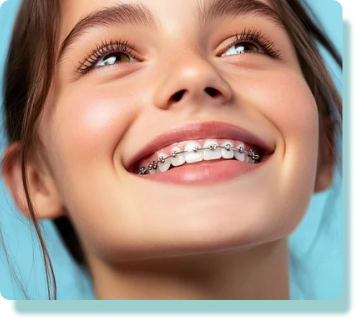
How do metal braces work?
- Treatment with braces takes about one to three years, depending on how far your teeth need to move.
- Decay and gum disease are treated before braces go on.
- The main risks are white marks on the enamel, shortened tooth roots, sore teeth and teeth moving back if you skip your retainer.
- Published prices for comprehensive metal braces at other Toronto-area clinics run about $4,000 to $6,000. Your own cost comes in a written estimate after an exam.
- The Canadian Dental Care Plan (CDCP) does not cover orthodontic treatment at present.
Metal braces work by putting steady, gentle pressure on your teeth through the archwire. Each bracket is bonded to the front of a tooth. Small elastic ties called ligatures hold the wire in the brackets.
The wire tries to spring back to its original shape, and that pull moves the teeth. The bone around each tooth reshapes to hold it in its new place. That is why treatment takes months and not weeks.
Which appliance suits you depends on how far your teeth need to move and how you feel about the look of metal. Dr. Julien Kim, an orthodontist at My City Dental, can go through how metal braces compare with clear braces and clear aligners at a consultation.
| Metal braces | Clear braces | Clear aligners | |
|---|---|---|---|
| What they are | Stainless steel brackets and a wire, fixed to the teeth | Tooth-coloured brackets and a wire, fixed to the teeth | A series of clear trays you take in and out |
| How they look | Metal shows on the front of the teeth | Less noticeable than metal | Hard to see when worn |
| What you have to do | Clean around brackets and avoid hard or sticky food | Same cleaning and food care as metal braces | Wear the trays for the hours set and take them out to eat |
| When they may not suit you | You do not want visible metal | Your bite needs a different appliance | You will not keep the trays in for the hours set |
Adult braces: is it worth getting braces at 40?
Yes, adult braces at 40 are worth a consultation if crowding, gaps or your bite bother you and your teeth and gums are healthy. Age alone does not rule you out. Adult braces work the same way as braces for teens, and Cleveland Clinic lists helping to prevent cavities and gum disease among the benefits of braces.
Adults bring things teens do not, such as crowns, fillings, missing teeth or receding gums. These are checked at your exam and planned around. Treatment for adults can take longer than treatment for teens.
Metal braces suit adults who want a fixed appliance with no trays to manage. If visible metal worries you at work, ask about clear braces or clear aligners at the same visit.
What is the average cost of metal braces in Ontario?
Published prices for comprehensive metal braces at other Toronto-area clinics run about $4,000 to $6,000. Your own cost comes in a written estimate after an exam.
Four things move the number:
- How far your teeth need to move.
- Whether one or both arches need braces.
- How long treatment runs.
- The retainers or extra appliances you need after.
Ask for each of them on your estimate.
Is $5,000 a lot for braces?
No. A price of $5,000 sits in the middle of the published Toronto-area range for comprehensive metal braces. Check what each estimate includes, such as retainers and adjustment visits, before you compare totals.
Can you get braces for $1,000?
Not for full metal braces at the published Toronto-area prices, where the lowest figure was $3,000. A short treatment that moves only a few teeth is a different plan with a different price. Ask whether it suits your case.
My City Dental has a $500 off braces offer. Ask our team whether the current $500 braces offer applies to your treatment plan before booking. Offers can change, so ask the team whether one applies to you when booking.
Are braces covered under OHIP, CDCP or Healthy Smiles Ontario?
No. OHIP does not cover dental services provided in a dentist's office, and braces are one of them. The CDCP Dental Benefits Guide states that orthodontic services are currently not available.
My City Dental accepts the Canadian Dental Care Plan for the services it does cover. Coverage depends on the service and your eligibility, and some services need preauthorization. Ontario's Healthy Smiles Ontario program for children and youth also lists braces as not covered.
What happens when you get metal braces?
Getting metal braces starts with a full dental exam and a talk about your goals and your options. X-rays are taken when the dentist decides you need them after your history and exam.
On the day the braces go on, each bracket is bonded to a clean, dry tooth and the archwire is set into the brackets. After that you visit regularly for adjustments and progress checks, on a schedule the dentist sets. The wire is changed or adjusted at these visits. When your teeth reach their planned positions, the brackets come off and the dentist recommends what comes next, including your retainer.
How long do you wear metal braces?
Treatment with metal braces takes about one to three years. The NHS gives 1 to 2 years for a fixed brace, and Cleveland Clinic gives about two years on average with some cases needing three. Your own length depends on how far your teeth move and on keeping your adjustment visits.
Do metal braces hurt?
Metal braces make your teeth feel sore and tender for a few days after they go on and after each adjustment. Brackets can also rub the inside of your cheeks and lips at first. Orthodontic wax over the rough spot helps.
Soft foods make the first days easier. Ask the team or a pharmacist which pain relief is right for you. Soreness usually settles within a few days. If it does not settle or a sore spot keeps getting worse, call the clinic.
What are the risks of metal braces?
The main risks of metal braces are white marks on the enamel, shortened roots, gum problems, allergy and teeth drifting back after treatment. A published review of orthodontic side effects lists all five.
- White spots (decalcification). Plaque that sits around brackets pulls minerals out of the enamel and leaves chalky white marks. These marks can stay after the braces come off. Brushing with fluoride toothpaste and less sugar lower the risk.
- Root shortening (root resorption). Moving teeth can shorten the tips of some roots. The change is usually small, and severe shortening is uncommon. If X-rays show it, treatment may be paused or changed.
- Gum problems. Plaque trapped around brackets inflames the gums, and moving teeth through untreated gum disease can damage the bone that holds them. Braces wait until decay and gum disease are treated.
- Allergy. Brackets and wires contain nickel, and some people react to it. Tell the team about any metal or latex allergy before treatment starts.
- Relapse. Teeth can move back toward their old positions if you stop wearing your retainer.
Living with metal braces: food and sports
What foods should you avoid with braces?
Avoid hard, crunchy and sticky foods with metal braces, because they break brackets and bend wires. That means nuts, hard candy, caramels, toffee and chewing gum. Cut apples and carrots into small pieces before you eat them. Keep sugary food and drink to mealtimes, since sugar feeds the plaque that causes white marks.
Can you play sports with braces?
Yes. Wear a mouthguard for contact sports and for any activity where a fall or a ball could hit your face. A blow to the mouth can damage brackets and cut your lips on them. Ask the team about a mouthguard that fits with braces.
What to do if a wire or bracket breaks
Call My City Dental at (905) 581-2228 if a bracket comes loose, a wire breaks or the end of a wire pokes your cheek. Emergency same-day care is offered when available.
- A poking wire. Cover the end with orthodontic wax and call the clinic. Do not cut or pull on the wire yourself.
- A loose bracket. Leave it on the wire if it is still attached. If it comes off, keep it in a small bag and bring it to your visit.
- A hard blow to the mouth or a knocked-out adult tooth. Hold the tooth by the crown, keep it in milk and see a dentist right away, or another emergency dental provider or a hospital if the clinic cannot see you. A knocked-out baby tooth is never put back in.
Call 911 or go to a hospital after a blow to the head that causes confusion, drowsiness or vomiting.
Call 911 or go to the nearest hospital emergency department if you have trouble breathing or swallowing, swelling that spreads toward your eye or neck, fever with facial swelling, or bleeding that will not stop.
If you think you have breathed in a piece of your braces, go to a hospital emergency department even if the coughing stops. Call 911 if you are choking or cannot breathe.
Why choose metal braces?
Metal braces handle a wide range of tooth movements. They work all day without relying on you to put trays back in. Your cost depends on your treatment plan and comes in a written estimate.
The trade-offs are real too. The metal shows, cleaning takes longer and some foods are off the menu until treatment ends.
Questions about metal braces
Are retainers necessary after braces?
Yes. A retainer holds your teeth in their new positions after the braces come off. Without one your teeth can drift back toward where they started, which undoes part of the work.
Retainers come as removable trays or as a thin wire fixed behind the front teeth. Your dentist tells you which type suits you and how long to wear it each day.
Can children and teens get metal braces?
Yes. Children and teens can get metal braces once enough adult teeth have come in, and the right time depends on how the teeth and jaws are growing. Cleveland Clinic gives 9 to 14 as a common age range for braces. Our page on dental braces for kids covers braces and orthodontic care for younger patients at My City Dental.
Can metal braces fix an overbite or underbite?
Metal braces correct many overbites and underbites by moving the teeth. Small elastics hooked to the brackets help change how the upper and lower teeth meet.
Some bite problems come from the size or position of the jaw bones. Depending on how severe they are and your age, they may need treatment beyond braces, such as jaw surgery with another provider. Your exam shows which kind you have and what treatment it needs.
How do you brush and floss with braces?
Brush with fluoride toothpaste in the morning, at night and after meals, and clean around each bracket. Use an interdental brush every day to clean between your teeth and under the wire. Floss threaders guide floss under the archwire. Check in the mirror after brushing and go back over any bracket that still has food or plaque on it.