
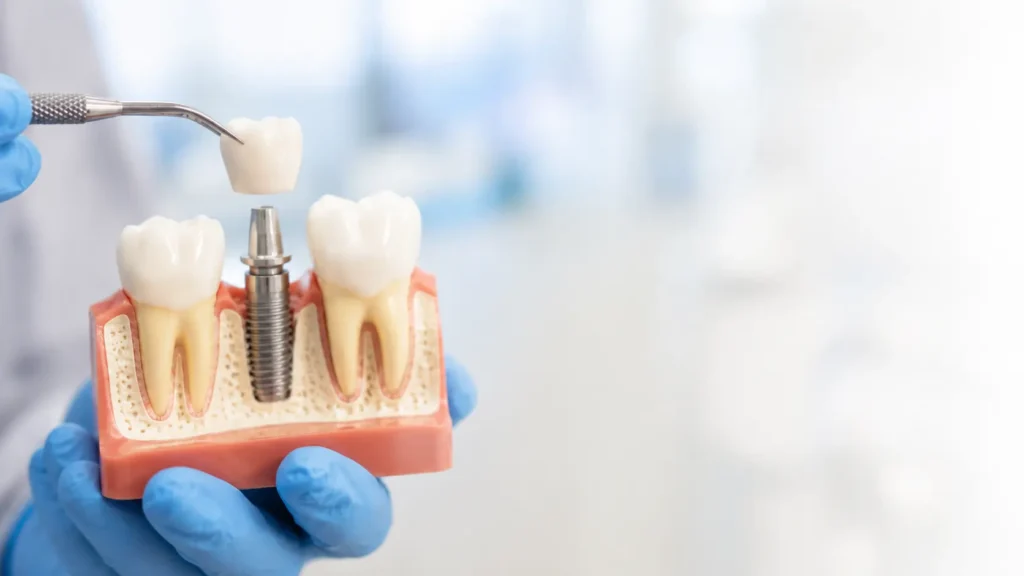
Which types of dental implants replace missing teeth?
Dental implants come in three main set-ups, chosen by how many teeth you are missing.
- Single tooth implant. One post holds one crown and the teeth on either side stay untouched.
- Implant bridge. Two or more posts hold a bridge that fills a gap of three or more teeth.
- Full-arch implants. Four to six posts hold a full upper or lower set of teeth. Ask the team whether a full-arch option suits you.
Implant dentures
Implant dentures attach to implants so the denture moves less when you eat and talk. Some snap on and off for cleaning. Others stay fixed and come out only at the dental office. Our dentures page compares implant-supported dentures with a standard denture.
Can implants replace a full mouth of teeth?
Full mouth dental implants replace every tooth in the upper jaw, the lower jaw or both. Cleveland Clinic describes four to six implants per arch holding a fixed bridge or a snap-on denture. Many people search for this as All-on-4.
A full arch needs enough healthy bone in the right places and more surgery than a single implant. Ask the team whether a full-arch option suits you once your exam is done.
Who are dental implants for, and who should wait?
Dental implants suit adults who have lost one or more teeth and have enough healthy bone and gum to hold a post. Mayo Clinic adds that you need to be willing to commit several months to the process.
Implants are the wrong first step if you have any of these:
- Active or untreated gum disease
- Extensive tooth decay in other teeth
- Unmanaged diabetes or another condition that slows bone healing
- Severe bone loss in the jaw that has not been treated
Smoking and vaping can disrupt healing, and smoking can play a part in implant failure. Tell the team about every health condition and every medicine you take.
If the bone is too thin or too soft, a bone graft aims to rebuild it before the implant goes in. A graft adds months of healing and carries its own surgical risks such as infection.
Some upper implants need a sinus lift first, a bone graft placed under the sinus, according to Cleveland Clinic. Ask the team whether My City Dental treats a complex case like yours or refers it on.
What happens at each step of implant treatment?
Implant treatment happens in stages with healing time between them.
- Exam and X-rays. The dentist checks your gums, your other teeth and the bone where the post would go. You get a treatment plan and a written estimate.
- Removing the tooth if needed. Ask the team whether a small graft at the same visit suits you.
- Placing the post. The area is numbed. The dentist opens the gum, places the post in the bone and closes the gum with stitches.
- Healing. The bone fuses with the post over three to nine months. Ask the team whether a temporary tooth suits you during this time.
- The abutment. A connector goes onto the post. Some cases need a small second procedure for this, and the gum then heals for at least two weeks.
- The new tooth. Your crown, bridge or denture is made from impressions or a digital scan and adjusted to your bite.
Nervous about surgery? Ask the team whether sedation suits you. The clinic bio of Dr. Reddy, a general dentist, lists an Oral and Nitrous Oxide Sedation License in Ontario.
Sedation can slow your breathing, so the team reviews your health history first.
Oral sedation leaves you drowsy and someone must drive you home. Do not drive or use machinery for at least 18 hours. Avoid alcohol and other sedating drugs for that time too, or longer if you still feel drowsy or dizzy. Nitrous oxide wears off faster, and the team will tell you when it is safe to drive.
Prefer to talk first? Call (905) 581-2228.
Does getting a dental implant hurt?
The area is numbed, so you should not feel pain during the procedure. Tell the dentist right away if anything hurts. Afterwards expect soreness, swelling of the gum and face, bruising and some minor bleeding.
The first round of healing takes about a week. Eat soft foods while the site heals and follow the team's aftercare advice. Call us if pain is not better within 48 hours, if swelling or soreness gets worse in the days after surgery, or if you notice pus, fever or a loose implant.
Every implant surgery carries risks. The main ones are infection at the site, damage to nearby teeth or blood vessels, and sinus problems when an upper post reaches a sinus. Mayo Clinic describes these risks as small.
Nerve injury is uncommon. It causes pain, numbness or tingling in the teeth, gums, lips or chin. It can last a long time and in rare cases it is permanent.
Call 911 or go to the nearest hospital emergency department if you have trouble breathing or swallowing, swelling that spreads toward your eye or neck, fever with facial swelling, or bleeding that will not stop.
How do you care for a dental implant?
You care for a dental implant much like a natural tooth. Brush twice a day and clean the gum line around the implant every day. Mayo Clinic suggests an interdental brush that slides between teeth and around the metal post.
Keep your regular check-ups so the dentist can check the gum and bone around the implant. Not smoking gives the implant a better chance.
What can dental implants do for you?
A dental implant gives you a tooth that stays fixed when you chew, speak and smile. Cleveland Clinic lists these benefits:
- Better chewing with a tooth that does not slip
- Clearer speech and steadier dentures
- Help keeping the jawbone from shrinking where a tooth was lost
Implants have limits too. They do not treat gum disease or decay in your other teeth, and some implants fail to fuse with the bone. The main downsides are the surgery and its risks, months of healing and a cost the CDCP does not cover.
Which tooth replacement fits you: implant, bridge or denture?
Tooth replacement comes down to three main choices: a dental implant, a tooth-supported bridge or a removable denture.
| Dental implant | Tooth-supported bridge | Removable denture | |
|---|---|---|---|
| Surgery | Yes, to place the post | No | No |
| Teeth next to the gap | Left untouched | Shaped to hold the bridge | Depends on the denture type |
| Stays in place | Fixed, or a denture that snaps on | Fixed | Taken out daily, rests on the gums |
| Time to finish | Several months, most of it bone healing | No bone healing wait | No bone healing wait |
| The wrong choice when | Gum disease is untreated, diabetes is unmanaged or the bone is too thin without a graft | The teeth either side are healthy and you want them left alone | You want teeth that stay fixed in your mouth |
A bridge or a denture costs less than an implant as a rule, according to Cleveland Clinic. An implant can last longer, so ask for a written estimate for each option. Our dental bridges page and dentures page cover those two options in full.
What do dental implants in Vaughan cost?
Dental implants at My City Dental start from $3,500. Final cost depends on what your case needs (for example the abutment and crown, bone grafting or an extraction) and is confirmed in a written estimate after an exam. Fees differ between Ontario clinics, so compare written estimates that list the same parts.
The cost of a tooth implant also changes with the number of posts and the teeth they hold. Offers can change, so ask the team whether one applies to you when booking.
The Canadian Dental Care Plan (CDCP) is accepted at My City Dental. The CDCP does not cover dental implants or any implant-related procedure, including implant-supported crowns and dentures, according to the government's CDCP dental benefits guide. It can cover other services, such as tooth removal and some dentures.
Coverage depends on the service and your eligibility, and some services need preauthorization. Our CDCP page explains how the plan works at the clinic.
OHIP does not pay for dental implants either. The Ontario government lists dental services provided in a dentist's office as not covered by OHIP.
Questions about cost? Call (905) 581-2228.
Dental implant questions
Is there an implant dentist in Vaughan?
My City Dental is a general dental office in Vaughan that offers dental implants. Dr. Reddy, a general dentist, provides dental implant services here, including implant placement, restoration and related surgical procedures. The same bio lists training in Minimally Invasive Tunneling Oral Surgery through the International Academy of Dental Implantology.
Can you get dental implants in one day?
You cannot finish dental implant treatment in one day, because the bone needs three to nine months to fuse with the post. In some cases a temporary tooth or set of teeth goes in on the day of surgery. That temporary set does not shorten bone healing, and your final teeth come later. Ask the team whether a temporary tooth on the day of surgery suits your case.
Are dental implants a permanent tooth replacement?
Dental implants are a long-term tooth replacement, and no implant is certain to last for life. Cleveland Clinic says implants can last a lifetime with brushing, flossing and regular dental visits. The crown, bridge or denture attached to the implant wears out sooner. Cleveland Clinic puts most crowns and bridges at around 15 years and most dentures at seven years or more.