
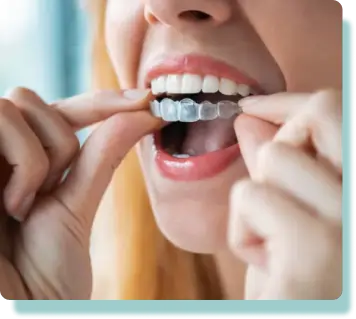
Who can benefit from clear aligners?
Clear aligners suit many cases of crowded teeth, gaps and mild to moderate bite problems. A dental exam tells you whether they suit yours.
- You wear the trays 22 to 23 hours a day, according to Cleveland Clinic.
- Some plans add small tooth-coloured bumps called attachments to help the trays grip.
- You wear a retainer afterwards to help stop your teeth moving back.
- Some mail-order kits skip the in-person dental exam.
- OHIP does not cover clear aligners. CDCP does not cover orthodontic treatment at present.
Clear aligners are used for these problems in teens and adults:
- crooked or crowded teeth
- gaps between teeth
- mild to moderate bite problems, where your upper and lower teeth do not line up when you close your mouth
- teeth that shifted after earlier braces
- small changes to how your front teeth line up
Who are clear aligners not right for?
Clear aligners are not right for teeth that need to move further than trays can manage, or for some complex bite and jaw problems. Fixed braces control those movements better.
Aligners also depend on you. If you will not keep the trays in nearly all day and night, braces fixed to your teeth suit you better.
Clear aligners for teens and adults
Clear aligners work for adults and for teens whose adult teeth have come in. The question at both ages is wear time.
Clear aligners for adults
Adults pick clear aligners because the trays are hard to spot at work and come out for meals. There are no brackets on the front of your teeth.
Clear aligners for teens
Clear aligners give teens a removable option instead of metal braces. Teens eat their usual food and clean their teeth without working around wires. Trays left in a backpack do not move teeth, so talk about wear time with your teen before you start.
What to expect during clear aligner treatment
Clear aligner treatment starts with an exam and ends with a retainer. The dentist builds the plan in between.
- Exam. The dentist checks your teeth, gums and bite and asks about your health. X-rays are taken only if the dentist decides you need them after your history and exam.
- Digital scan. A digital impression of your teeth replaces putty moulds. The clinic's digital impressions page explains the scan.
- Treatment plan. The dentist explains what the aligners aim to change and what braces would involve instead.
- Your trays. You move through a series of custom trays. Ask the team whether your plan needs attachments.
- Progress checks. The dentist recommends what comes next and when.
- Retainer. Once your teeth reach their planned position, a retainer helps hold them there.
How long does clear aligner treatment take?
Cleveland Clinic gives about nine months for a few slightly crooked teeth. Bigger problems take longer. Your dentist gives you an estimate at the exam, and missed wear hours push it back.
What are the benefits of clear aligners over braces?
Clear aligners are harder to notice than braces and come out of your mouth for meals and cleaning. Cleveland Clinic notes they come with fewer food rules and cleaning routines than braces.
- Clear trays that are hard to spot when you talk
- No brackets or wires to rub your cheeks and lips
- No wires to tighten
The trade-off is time and discipline. Braces can fix some problems faster. Aligners can need extra trays to reach the same result.
Invisalign is one of the clear aligner systems used at our Vaughan clinic.
What are the side effects and risks of clear aligners?
Clear aligners can cause pressure or soreness when you start each new tray, and the soreness usually eases within a few days. Soft foods such as soup or scrambled eggs help meanwhile.
Call the clinic if the pain is sharp or lasts more than a few days. Call too if your gums bleed or swell or a tray feels loose. Teeth can also fall behind the plan, which adds trays and time. Without the retainer they can drift back.
Moving teeth can also shorten their roots. The change is permanent, and in most people it is small. If X-rays show it, the dentist changes or pauses your treatment.
Call 911 or go to the nearest hospital emergency department if you have trouble breathing or swallowing, swelling that spreads toward your eye or neck, fever with facial swelling, or bleeding that will not stop.
How do in-office clear aligners compare with mail-order kits?
In-office clear aligners begin with an exam by a dentist who sees your teeth, gums and bite in person. Mail-order kits skip that visit. You take a mould of your own teeth or get a scan at a storefront, and new trays arrive by mail.
A 2020 survey of 470 mail-order users in the United States, published in the Journal of the American Dental Association, set out the trade-off. Cutting out in-person supervision let the companies charge thousands of dollars less. Yet 6.6% of the users surveyed had side effects bad enough to need a visit to their own dentist. At the time, dentists at most of these companies did not review X-rays or other dental records before approving treatment.
The American Dental Association warns that moving teeth without knowing the full condition of the mouth can cause bone loss, lost teeth, receding gums, bite problems and jaw pain.
| In-office clear aligners | Mail-order kits | |
|---|---|---|
| Exam before treatment | In person: teeth, gums, bite and health history | Not always in person |
| X-rays | Taken when the dentist decides you need them | Not reviewed by most companies, per the 2020 study |
| Progress checks | With your dentist, who recommends what comes next | Online messages, and many companies offer no direct line to a dentist |
| When it may not suit you | You will not wear trays 22 to 23 hours a day, or your teeth need fixed braces | You have gum disease, decay, a bite problem or jaw pain that no dentist has checked |
Where can you get clear aligners in Vaughan?
You can get clear aligners in Vaughan from orthodontic offices, general dental clinics and mail-order companies. An orthodontic office focuses on moving teeth and jaws. A general dental clinic also handles your cleanings, fillings and check-ups in the same office during treatment.
My City Dental is a general dental clinic on Keele Street. The team includes Dr. Kim, an orthodontist with a Specialty Diploma in Orthodontics and an MSc from the University of Toronto. Ask the team who will plan your treatment and why.
What is the average cost of clear aligners in Ontario?
Clear aligners cost about $3,500 to $4,500 for mild cases and about $6,000 to $8,000 for comprehensive treatment, going by published Invisalign prices. We found no three local clinics that publish a price for clear aligners in general, so both ranges are for the Invisalign brand.
The comprehensive range comes from published prices at other Vaughan and Toronto-area clinics. The mild-case range comes from Toronto-area clinics. Your own cost comes in a written estimate after an exam.
The number of trays your teeth need and any refinements move the price. So does whether retainers and check visits are in the fee.
Is $5,000 a reasonable price for clear aligners?
A $5,000 quote for clear aligners sits between the mild-case and comprehensive ranges above. Judge it by what it buys. Ask how many trays it covers and whether refinements, retainers and check visits are included.
Clear aligner questions
Are clear aligners the same as clear braces?
Clear aligners are sometimes called clear braces, clear invisible braces or invisible dental braces. They are not ceramic braces.
Ceramic braces, also sold as clear braces, use tooth-coloured brackets glued to the teeth and joined by a wire. Clear aligners use removable trays with no brackets at all. If you want fixed braces that are hard to notice, our clear braces page covers the ceramic option.
Does OHIP cover clear aligners?
No, OHIP does not cover clear aligners, including Invisalign. The Ontario government says OHIP does not pay for dental services provided in a dentist's office. The CDCP benefits guide says orthodontic services are currently not available. For other care, CDCP coverage depends on the service and your eligibility.
Some private plans include orthodontic benefits. Ask your insurer for a predetermination, which is an estimate and not a promise to pay. My City Dental offers direct insurance billing.
What is the right age for clear aligners?
No single age is right for everyone who wants clear aligners. NHS guidance says orthodontic treatment is often recommended for children and teenagers after all their adult teeth have come through, and adults can have it too. For a younger child whose jaws are still growing, our children's orthodontics page covers that age group.
Can you eat and drink with clear aligners in?
No, you take clear aligners out to eat and drink, and Cleveland Clinic says to store them somewhere safe while they are out. Use their case. A tray wrapped in a napkin is easy to throw away.
You also take them out to brush and floss. Every break counts against your 22 to 23 hours of daily wear, so keep meals and snacks to set times.