
Gingivitis vs periodontitis: what is the difference?
Gingivitis is the early stage of gum disease and affects only the gums. Periodontitis is the advanced stage, where the infection breaks down the gum attachment and the bone around your teeth. Untreated gingivitis can turn into periodontitis.
| Gingivitis | Periodontitis | |
|---|---|---|
| What it affects | The gums only | Gums, gum attachment and bone |
| Typical signs | Red, puffy gums that bleed when you brush | Receding gums, deep pockets, bad breath, loose teeth |
| Can it be reversed? | Yes, with a cleaning and daily home care | No. Treatment aims to stop further damage |
What are the signs of gum disease?
The first signs of gum disease are gums that bleed when you brush or floss and gums that look red or puffy. Gingivitis does not hurt in most people, so these signs are easy to ignore. Book an exam if you notice:
- Red, swollen or tender gums that bleed when you brush or floss
- Bad breath or a bad taste that will not go away
- Receding gums that make your teeth look longer
- Pus between your teeth and gums
- Loose or shifting teeth, or a change in your bite
- Pain when chewing
When do bleeding gums need prompt care?
Bleeding gums need a prompt dental visit when they bleed every time you brush. Book sooner if the bleeding comes with pain, swelling or a loose tooth. Very sore gums or a painful swelling with pus may mean an abscess and need an urgent appointment.
Call 911 or go to the nearest hospital emergency department if you have trouble breathing or swallowing, swelling that spreads toward your eye or neck, fever with facial swelling, or bleeding that will not stop.
For urgent dental care, call (905) 581-2228. Emergency same-day care when available.
Why treat gum disease early?
Early treatment matters because gingivitis is reversible and periodontitis is not. Once the bone around a tooth is gone, it does not grow back by itself. Treating gum disease early aims to stop the pockets getting deeper, keep the bone that holds your teeth and avoid surgery later.
What increases your risk of gum disease?
Smoking raises your risk of gum disease by 85% compared with not smoking, according to Health Canada. It also lowers the chance that treatment works. The risk starts to fall as early as one year after you quit.
Diabetes raises the risk about threefold, according to a 2012 review in the journal Diabetologia. The link runs both ways, since gum inflammation makes blood sugar harder to control.
Hormonal changes such as pregnancy also raise the risk. So do medicines that cause dry mouth, vaping, a weak immune system and a family history of gum disease. Risk factors do not confirm a diagnosis. Only an exam can.
Is gum disease linked to heart disease?
Studies link gum disease to heart disease, but they have not shown that one causes the other. A 2012 American Heart Association scientific statement found the link holds after allowing for shared risks such as smoking and diabetes. It found no evidence that treating gum disease prevents heart disease.
How is gum disease diagnosed?
Gum disease is diagnosed with a gum exam. The dentist slides a thin probe between each tooth and the gum to measure the pocket. Healthy gums attach just below the gum edge. Deeper pockets, bleeding and loose teeth point to periodontitis.
Dental X-rays show the bone around your teeth. The dentist takes them when your history and exam show you need them.
What are the options for gum disease treatment in Vaughan?
The first treatment for gum disease is a thorough cleaning that removes plaque and tartar, plus better daily brushing and flossing. Gum therapy at My City Dental in Vaughan steps up only as far as your gums need.
Professional cleaning for gingivitis
A professional cleaning treats gingivitis by removing the tartar you cannot brush away. A routine cleaning is not enough once periodontitis has formed pockets.
How is periodontitis treated?
Periodontitis treatment in Vaughan starts with scaling and root planing, a deep cleaning below the gumline. Scaling removes plaque and tartar from the roots. Root planing smooths them so the gums have a chance to reattach. Deep cleaning is not needed for gingivitis alone.
The dentist can numb the area to reduce discomfort. Tell the dentist if anything hurts. Treatment may take more than one appointment.
The American Dental Association says you may have sore gums for a day or two and sensitive teeth for up to a week. Call us if either gets worse or has not settled by then.
Periodontal maintenance
Periodontal maintenance is a cleaning schedule set for gums that have had periodontitis. The interval depends on your pockets and home care and on how your gums respond. The dentist recommends what comes next.
When is gum surgery needed?
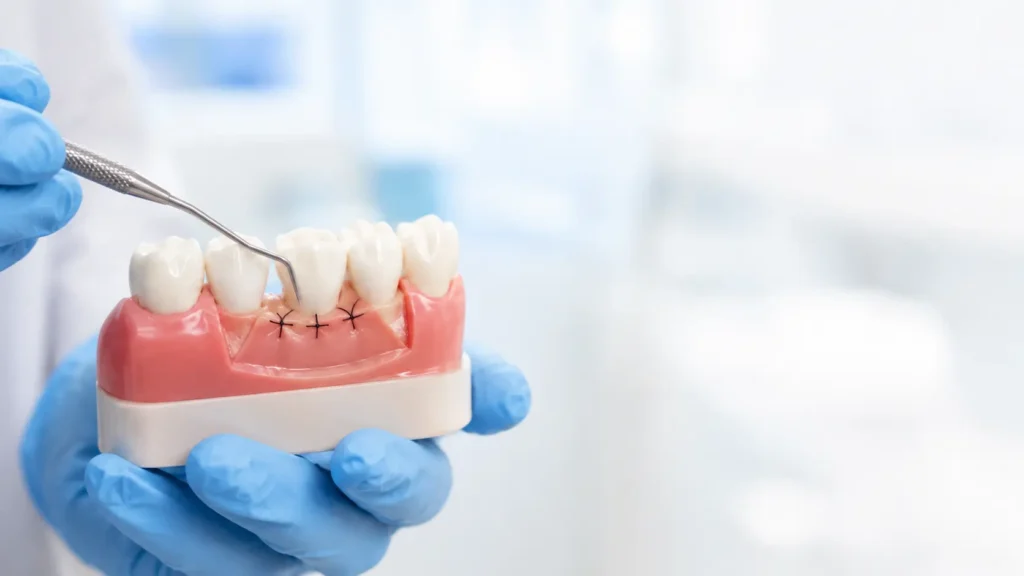
Gum surgery is for pockets that stay deep after scaling and root planing and for gums that have receded from the roots. In flap surgery the dentist folds the gum back to clean the roots and then stitches it in place. A gum graft aims to cover exposed roots.
Risks include infection, more sensitive roots and a change in gum shape. Our gum surgery page covers the procedures and recovery. For serious disease that does not improve with normal care, the dentist tells you whether care here or a referral suits you.
Want your gums checked? Call (905) 581-2228.
Can gum disease go away completely?
Gingivitis can go away completely. Periodontitis cannot be cured, but you can control it. Some surgeries aim to rebuild part of the lost bone and gum.
Home care and maintenance visits help control periodontitis. If it persists or comes back, you may need more treatment.
How do you care for your gums at home?
Brush for two minutes twice a day with fluoride toothpaste and clean between your teeth once a day, as the Canadian Dental Association advises.
- Use a soft brush angled toward the gumline
- Clean between your teeth with floss or small interdental brushes
- Stop smoking or vaping. Health Canada's free quit line is 1-866-366-3667
- Report new bleeding, swelling or loose teeth
How much does gum disease treatment cost?
The cost depends on the stage of the disease, so no single fee covers it. What changes the cost:
- How many areas need scaling, billed in time units
- Whether local anaesthetic is needed
- Dental X-rays, when the dentist decides you need them
- The number of maintenance visits
- Any surgery or referral
Deep cleaning and gum grafts for receding gums each have their own page that explains their cost. Your own cost comes in a written estimate after an exam.
Does insurance cover gum care?
Many private dental plans pay part of the cost of gum exams, scaling, root planing and maintenance. My City Dental offers direct insurance billing. Ask for a predetermination first. It is an estimate of what your plan may pay, not a promise.
Does CDCP cover gum disease treatment?
The Canadian Dental Care Plan covers scaling and root planing for eligible patients within yearly limits. The CDCP Dental Benefits Guide allows adults 17 and over up to 4 units in any 12 months, and more units need preauthorization. Crown lengthening and bone grafts are not covered by the CDCP.
My City Dental accepts the Canadian Dental Care Plan (CDCP). Coverage depends on the service and your eligibility, and some services need preauthorization.
Frequently Asked Questions
What kind of doctor should I see for gum disease?
Start with a general dentist. A dentist diagnoses gum disease with a gum exam and X-rays when needed. The first treatments are cleaning and deep cleaning. For serious disease that does not respond to normal care, the Canadian Dental Association says your dentist may refer you to a dentist with at least three years of extra university training in gum disease.
Can I go straight to a periodontist?
Policies differ between offices. Call the periodontics office and ask whether it needs a referral.
Ask your dentist to share your X-rays and pocket chart. The new office decides whether any tests need repeating. The CDCP and some insurers ask for a recent pocket chart before they approve some treatment.
How long until teeth fall out with gum disease?
There is no set timeline. The speed depends on how much bone you have lost and how well plaque is controlled. Smoking and diabetes speed it up. Treatment aims to slow or stop that loss, so book soon if a tooth feels loose.
What if I can't afford periodontal treatment?
Tell the team, because there are options. Check whether you qualify for the Canadian Dental Care Plan. With private insurance, ask for a predetermination to see what your plan may pay and what you may owe and ask the team about payment options. The Canadian Dental Association also suggests social services for government-funded care and dental school clinics, where senior students treat patients at reduced cost.